

Stepping out of the chaos of Cairo to discover the Pyramids of Giza
By Sarah Kingdom, Contributor. Sarah Kingdom covers travel, with a focus on sustainable luxury.

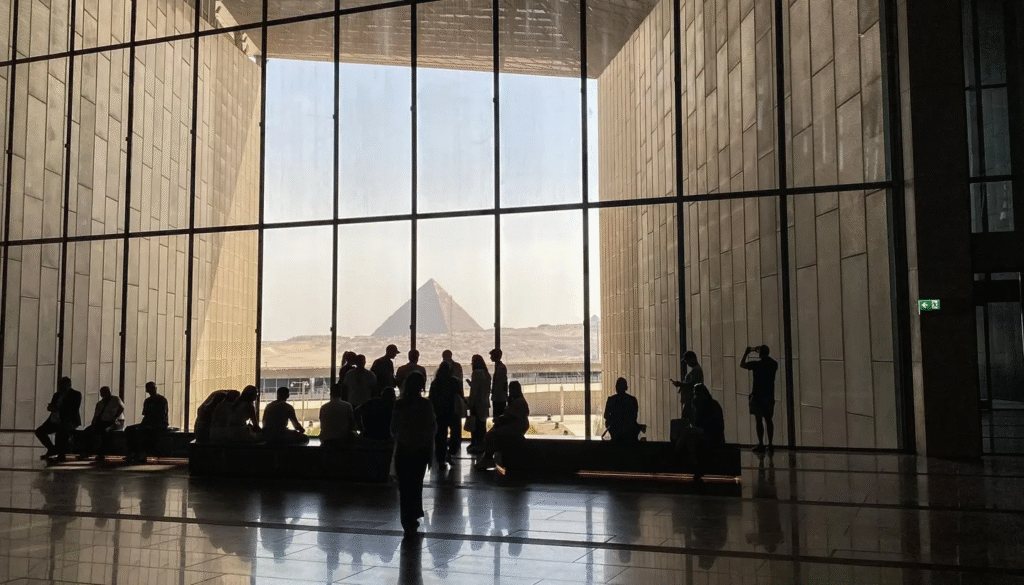
From the glass atrium of the Grand Egyptian Museum, the three great Pyramids of Giza are perfectly framed on the desert horizon. The architects designed it this way; a deliberate alignment connecting the modern museum to the ancient necropolis just beyond its walls. Inside the GEM, beneath a ceiling high enough to hold history itself, are more than 100,000 artefacts, including the full collection of Tutankhamun’s treasures. It’s an extraordinary introduction to ancient Egypt. And then, when you step outside, the real thing, the pyramids themselves, just a five-minute drive away.
The Giza Plateau
When people speak of ‘The Pyramids’, they’re typically referring to the three large pyramids on the Giza plateau, on the outskirts of Cairo. Constructed almost 5,000 years ago, these are the Great Pyramid and its two neighbors, the pyramids of Khafre and Menkaure.

The World’s Oldest Tourist Attraction
Built during Egypt’s Fourth Dynasty, the pyramids on the Giza Plateau has been drawing visitors for thousands of years. The earliest records of tourists dates back to the 5th century BCE, when Greek historian, Herodotus, visited and wrote about them.

The Great Pyramid, is the oldest of the three main pyramids on the plateau. Built around 2570 BC, this is the oldest of the Seven Wonders of the Ancient World – in fact, it is the only Ancient Wonder that still remains predominantly intact. Also known as the Pyramid of Khufu or Pyramid of Cheops and originally 481ft tall, it’s comprised of over 2.3 million limestone and granite blocks, each weighing around 15 tons; a feat of engineering precision that is still much debated by scholars today. The pyramid took an estimated 20 years to complete, and for the next 3,800 years remained the tallest building in the world, until Lincoln Cathedral was built in England in 1311 AD.
Climb the steps to the pyramid’s entrance and marvel at how small you felt looking up towards the top. Stand here long enough and you’ll begin to sense the weight of millennia, and the astonishing ingenuity that made such a monument possible.

Adjacent to the Great Pyramid, are the Boat Pits, where the magnificent wooden solar boats of Khufu were once buried. Huge, ceremonial wooden ships, made primarily of cedar, and intended to transport the deceased pharaoh’s soul on its journey through the afterlife. (The boats are now preserved in a special exhibition at the GEM).

Next door, Khafre’s Pyramid, the remnants of its original smooth casing stones still gleaming at its summit, is slightly smaller, but built on higher ground, creating an illusion of dominance. Built around 2570 BCE, for Khufu’s son, the pyramid was one of the most sophisticated of its time, and incorporates the Valley Temple and a Mortuary Temple, the site of ritual mummification, before the body was carried up a basalt-paved causeway to the pyramid itself.

In front of the causeway and carved from a single limestone ridge, sits the enigmatic Great Sphinx, its massive paws resting in the sand, its face turned eternally toward the sunrise. Believed to bear Khafre’s features, its lion body and human face is one of the oldest surviving sculptures on earth. From up close, you can see traces of the ancient pigment that once gave it its original color.

The third of the major pyramids at Giza belongs to Menkaure. It’s surrounded by three small pyramids, believed to be tombs for his queens. Built around 2,490 BCE, at 213ft this is the smallest of the three pyramids. It was once partially clad in polished red granite, an unusually lavish choice that set it apart from the limestone exteriors of its neighbors. Though smaller in size, Menkaure’s pyramid is renowned for its elegant proportions, its well preserved mortuary complex, and a stunning collection of statues that were discovered inside.

Triad of Menkaure – king Menkaure wearing the white crown of Upper Egypt, with the goddess Hathor to his right and the 17th nome of Upper Egypt to his left, in a sculpture taken from the Valley Temple of the Pyramid of Menkaure at Giza,
While the three pyramids and the sphinx dominate the plateau, they are surrounded by several other buildings and monuments. Every king’s pyramid was just one element of a larger complex that included queens’ pyramids, satellite pyramids (symbolic tombs for the pharaohs), mastaba tombs (for nobility and other family members), temples, cemeteries, and the remains of a workers’ village.
Accessing The Pyramids: The VIP Way
Alongside the opening of the Grand Egyptian Museum, the entrance to and experience of the Giza Plateau has been revamped. In an effort to alleviate congestion and address environmental concerns, the historic entrance, near the Marriott Mena House, has been replaced with a new entrance, located on the Fayoum Highway, south of the Pyramids. The revised entrance system also prohibits private vehicles and tour buses from entering the complex, instead providing eco-friendly electric busses, scheduled to run at 5 minute intervals, for a hopefully cleaner and more sustainable experience.
There is also a new VIP entrance, complete with air-conditioned lounge and private golf cart experience. It’s a world apart from the shuttle bus bustle, though it must be booked in advance through a private tour company.

From a morning spent at the GEM with the supremely knowledgeable Egyptologist Eman Shawky Mahmoud, together we headed for the pyramids. Our expert travel planner, US-based Sheri Fazleabas, owner of A&S Signature Journeys, had made arrangements for VIP entrance tickets. On arrival we were escorted to a waiting electric golf cart, a simple but game-changing luxury allowing us to traverse the plateau’s vast distances with ease, and more importantly in our own time, without being tied to the shuttle bus schedule. The plateau covers more than 500 acres, and under the Egyptian sun, that’s no small consideration.
Lunch With A View
After spending time among ancient kings, lunch was a return to the present, though at 9 Pyramids Lounge, history never really left the frame. Directly opposite, was an uninterrupted view of the pyramids, complete with camels and visitors moving like silhouettes against the sand. (This is one of the complex’s most in-demand restaurants, for locals and visitors alike, so book in advance to ensure a table with panoramic views).

Over lunch I think back to our morning at the Great Egyptian Museum, and how the pyramids had shimmered in the distance. I think of how it had felt, standing at the base of Khufu’s Great Pyramid. I think of our lunch view, the same one that has captivated travelers for thousands of years. Despite having seen countless photographs before, nothing had prepared me for the sheer presence of the pyramids; immense, geometric, and timeless, standing on the edge of Cairo’s urban sprawl, where the desert begins.